Flying Fox Fabrics evolved from combining a number of passions: fabrics, Indigenous art Cambodia and social enterprise.
My name is Felicity (aka Flick) and I’ve been a textile enthusiast/tragic since childhood. I learned to sew at five years old, was knitting soon after, travelled to Papua New Guinea to visit my oldest sister when I was 10 and came back with two bilums and a hand-loomed woollen rug, took up spinning at 13 and studied garment construction at tertiary level. I was constantly making things and learned along the way that I have an inbuilt love of natural fibres and an aversion to petrochemical fibres.
Yuendumu – Warlukurlangu Artists
Visiting Yuendumu in April 1986 I watched the batik artists with delight. A few weeks later, I unexpectedly got the gig as the first art coordinator of Warlukurlangu Arists (1986-88) and in June, in we were on a bus to Darwin (my first time ever). The artists were Peggy Napurrurla Poulson, Margaret Napangardi Lewis, Lottie Napangardi Robertson, Beryl Napangardi Robertson, Gladys and Wilma Napangardi Poulson to an exhibition at Warehaus Gallery called Warlpiri Hands Warlpiri Country facilitated by Chips Mackinolty.
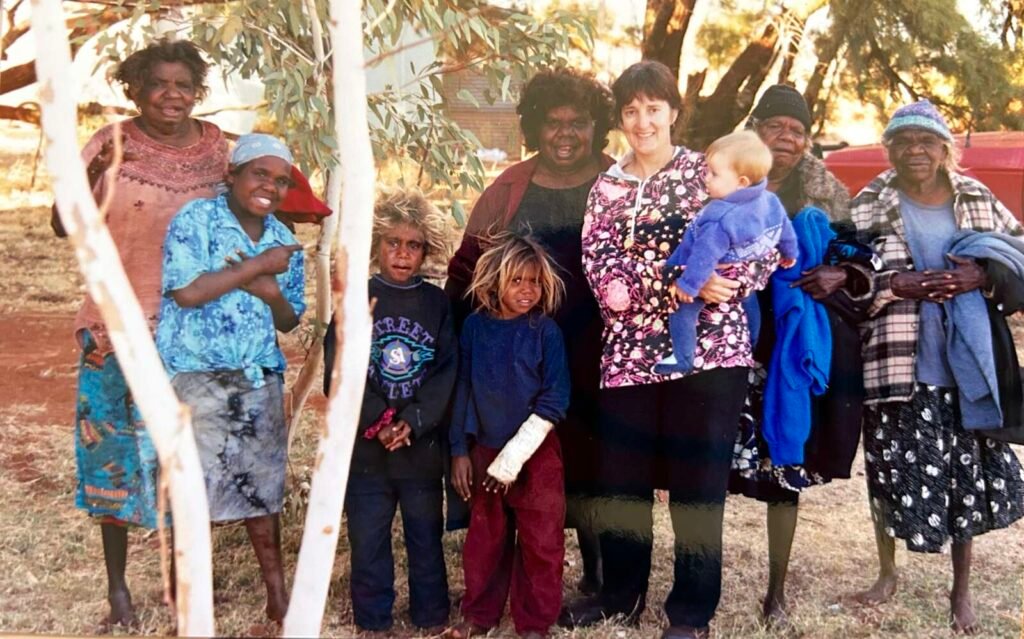
Over the decades I have both stumbled over and sought out opportunities to be involved with making and promoting beautiful fabrics. I have been especially lucky to spend my adult life surrounded by Indigenous Australian textiles – batiks, screen-printed and lino-printed fabrics, natural fibre weavings, ghost net weavings and more. The header photo was taken at Injalak Arts with Daniel Garlngarr and Reuben Manakgu – who made me smile and proud every day I worked there.
My CV includes working with Indigenous Australian artists in more than 70 remote and regional communities/towns. Whilst I love all forms of Indigenous art/culture, textiles are closest to my heart. At Warlukurlangu Artists (1986-88) I’d overseen batik production alongside the paintings and supported exhibitions. I’d had the privilege of being the first Manager of Injalak Arts (1991-95). In those days the screen print workshop was a focus of Injalak Arts’ production. In the years since I had undertaken a number projects and consultancies with art centres that screen printed on fabric including Tiwi Designs, Jilamara Arts, Ernabella Arts, Babbarra Designs, Erub Arts and Bula’bula Arts.
Volunteering in Cambodia
Flying Fox Fabrics was born after a life-changing Australian Volunteers International placement in Cambodia from 2010-12. I lived in an apartment in Riverside, Phnom Penh in Street 178 directly opposite the National Museum. Kravan House, a little shop one block away stocked beautiful handwoven silk scarves and a range of bags and purses made from ikat, silks and cotton fabrics. The owner, Thanan Hok, was friendly and welcoming and explained she’d set up Kravan House to employ and empower people with disabilities and she supported a workshop just north of the city. She had been born with physical disabilities and found the discrimination extremely unfair and frustrating and so took the plunge of setting up her own business in that same location in 2003. I love social enterprises and fair trade, plus I love quality handicrafts so this little shop was my happy place.
Returning to Injalak Arts
In early 2013 I was invited to Injalak Arts to undertake a change management/business planning consultancy for the Corporation. It was going to be short term, as I still had commitments in Cambodia. After unsuccessfully recruiting for a new manager (the successful applicant pulled out the day before they were due to fly in) and with dry season imminent I agreed to stay on for the season. One season turned into six years. One of my favorite things about being back at Injalak Arts was the new fabric designs and the enthusiasm of the artists and printers. A range of new designs were created in 2011-12, before I returned, and over the next 6 years a further 20+ designs were created in a series of workshops delivered by Jude White and focussing on women’s participation. The women became outstanding textile artists and exemplary printers.
What do we do with all this fabric?
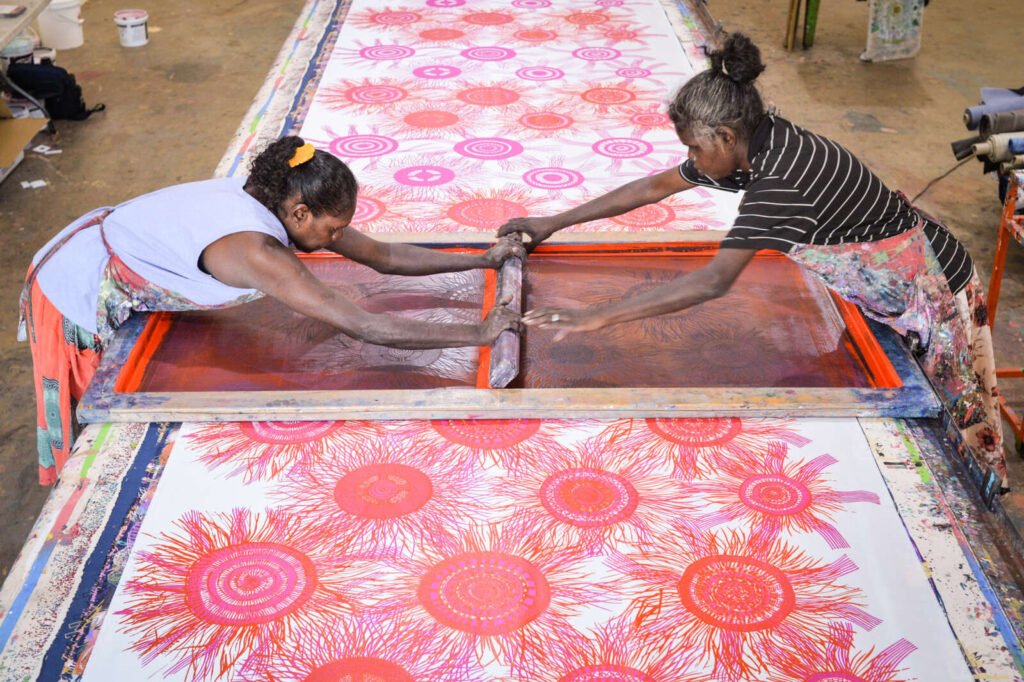
The Injalak Arts print workshop stepped up production and we were printing up to 32 metres per day, 6 days a week – but we needed to sell it all or there was no reason to continue printing. In dry season we sold direct to tourists, but, as many people do not sew the market was limited. We were thinking about how to value add to the fabrics and then I remembered the bags I bought as gifts in Cambodia, some of them had been made from locally hand printed fabric. I approached Thanan in 2013 and she agreed to create a sample range of bags made from Injalak Arts fabrics.
Cross cultural Collaboration (CCC) Project
The project was started with around 25 metres of fabric and one partner – Kravan House. The first batch of bags and purses came back to Australia – and the artists loved them. Happily so did the public and some found their way to the National Museum Shop. Over time the project grew significantly and worked with three more social enterprises in Cambodia. Injalak Arts sold thousands of bags, purses, backpacks, cushion covers and later, clothes. The CCC Project also saw many clothes made including uniforms and dresses, much loved by the artists. The project belonged to Injalak Arts and I facilitated it as part of my role as Mentor Manager. All proceeds from the CCC Project went to Injalak Arts.
Flying Fox Fabrics
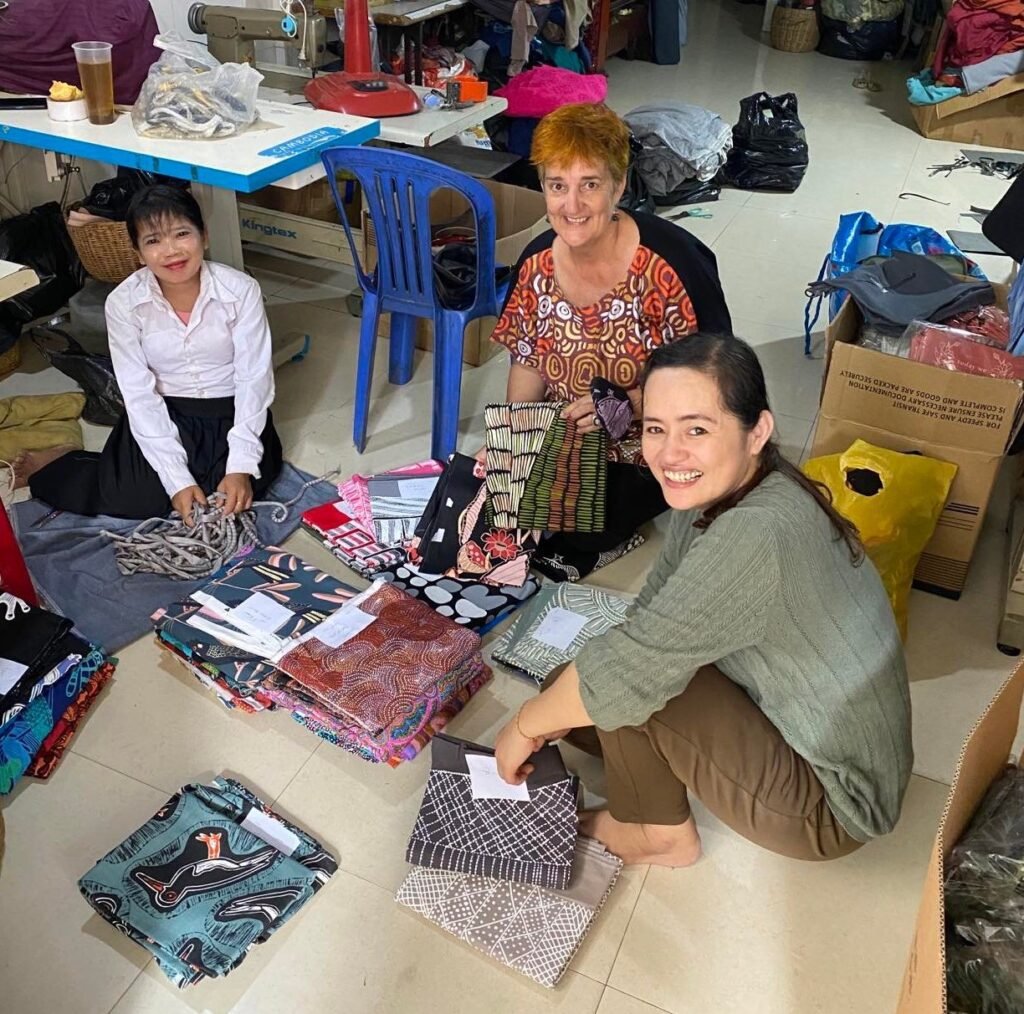
Leaving my role at Injalak Arts in February 2019 I thought that the CCC Project would continue and I offered to facilitate from offsite, however, new management decided not to continue the project. The Cambodian partners were suddenly left high and dry, they had just lost one of their major wholesale partners. They all asked me to continue.
Moving to Darwin
In 2021 Flying Fox Fabrics moved from Coffin Bay in South Australia to Darwin. Once there we continued to sell and promote via Etsy and our online store.
